
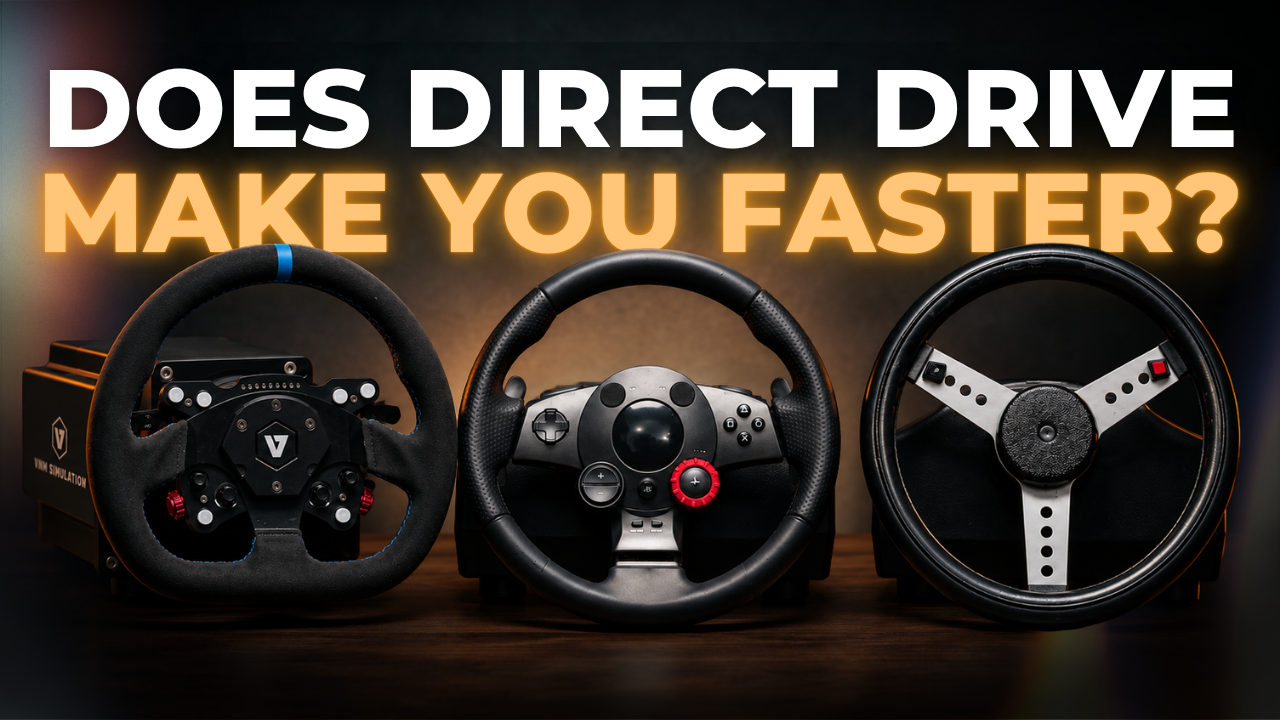
A 32Nm direct drive wheelbase costs a lot more than a Logitech wheel from 2007 or a spring-loaded wheel from the 1990s. But how much faster does it actually make you? To find out, Darin Gangi and three sim racers from the Sim Motion team ran real direct drive lap times in iRacing, then did the same on a Logitech Driving Force GT and a Thomas Super Wheel, the same kind of wheel and pedal set Darin raced on for about a decade.
The short version: direct drive was fastest for all four drivers. But the gap ranged from about three tenths of a second to around a second and a half, and when we asked what made the biggest difference, two of the four drivers, Darin included, said it was the pedals, not the wheelbase. Watch the full test below, or read on for the lap times and what the drivers said.
Watch: Does Direct Drive Actually Make You Faster? 4 Drivers Put It to the Test
The Three Setups
The test spans about 30 years of sim racing hardware, from no force feedback at all to 32Nm of direct drive torque.
| Thomas Super Wheel (TSW) | Logitech Driving Force GT | VNM direct drive setup | |
|---|---|---|---|
| Era | 1990s | Released December 2007 | Current |
| Force feedback | None (spring-loaded) | Yes | 32Nm direct drive |
| Rotation | 270° | 900° | Not covered in the video |
| Pedals | Potentiometer, no resistance | No resistance | 200kg load cell brake |
| Mounting | Pedals sat on rubber pads, unbolted | Wheel clamps; pedals ratchet strapped down | Bolted to a Sim Motion 160mm chassis |
| Price when new | About $400 (Darin’s recollection) | Under $200 (Darin’s recollection) | Current pricing at the product links below |
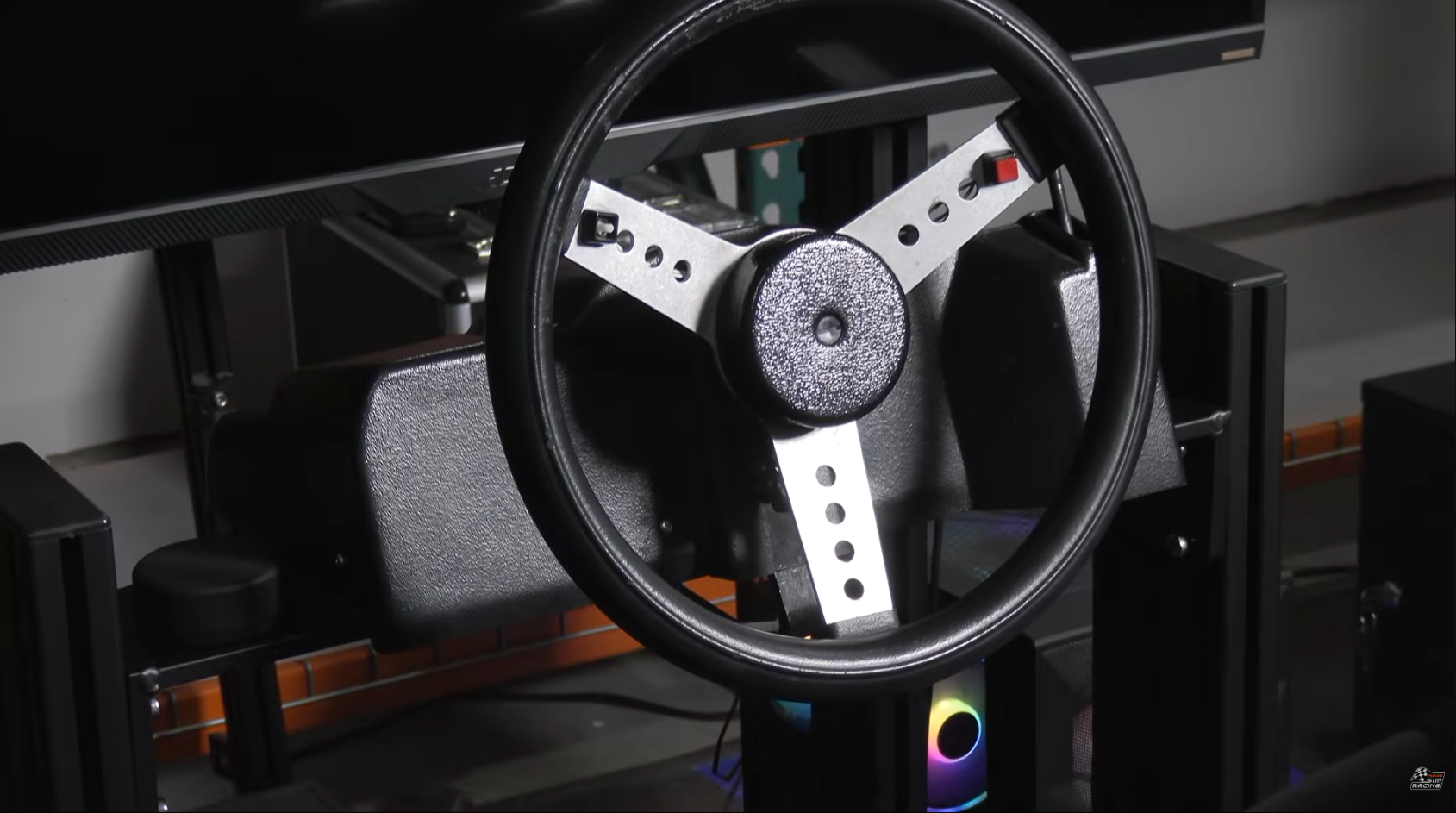
Thomas Super Wheel
The TSW is a spring-loaded wheel with no force feedback, and its pedals use potentiometers, which work a lot like the dimmer switch on a light. Potentiometers were the weak point, Darin remembers, and they were always wearing out. You also shift with a small handle on the unit itself. The TSW in this test belongs to Cole’s dad, who has had it since the late 1990s or early 2000s.
Logitech Driving Force GT
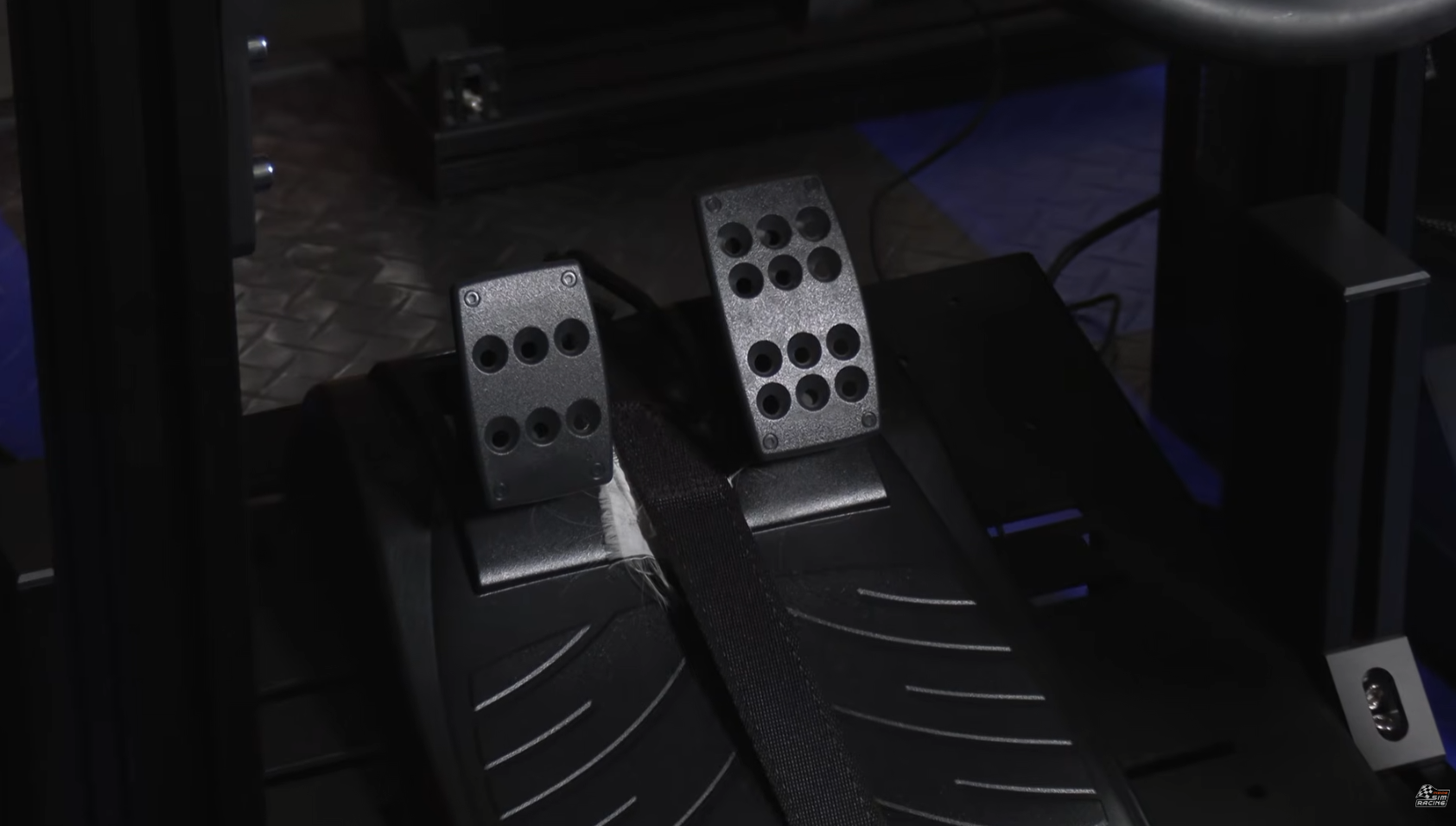
The DFGT was the budget version of the Logitech G25 and worked with PlayStation. It has 900 degrees of rotation and force feedback, though Darin noted it’s light by modern standards. It only mounts with clamps, and the pedals have carpet grabbers underneath, so the team ratchet strapped them to the pedal deck. It ran on a Sim Motion 80mm chassis.
VNM Direct Drive Setup
The modern setup combined the VNM Xtreme 32Nm direct drive wheelbase(opens in new tab), a VNM Apex-R hub, a Sim Motion D-shaped Alcantara rim, and VNM’s load cell pedals(opens in new tab) with a 200kg load cell, all on a Sim Motion 160mm chassis.
Darin’s 30 Years of Sim Racing Wheels
Before the lap times, Darin took a trip down memory lane, and it explains why that TSW meant so much to him.
Before wheels. Darin has been sim racing since the early 1990s. His first title was Papyrus’ Indianapolis 500, bought at a local software store around 1989 or 1990 and run on his mom’s PC. With no wheel, he tried every joystick combination and the keyboard, and never got comfortable. (His hint for newer sim racers: look up Papyrus and its connection to iRacing.)
The bungee wheel. Papyrus followed with IndyCar Racing and then NASCAR Racing, and an ad in the IndyCar box introduced Darin to the Thrustmaster T1. He got one as soon as it came out in 1994. Known as the bungee wheel, it had pedals with small leaf springs that snapped easily, though Thrustmaster was good about sending spare parts. As rough as it was by today’s standards, it finally let him turn real laps.
CompuServe leagues. Back then, Darin found sim racing forums on CompuServe and joined two leagues, one for the IndyCar title and one for NASCAR. Drivers ran their races offline with set AI and race parameters, submitted their results, and the league compiled season standings. He even became an admin of the IndyCar league for a while.
Winning a TSW. The NASCAR league gave away three TSW wheel and pedal sets to drivers who submitted results for one event, and Darin won one. It was a huge step up from the T1. He later bought another TSW with a D-shaped wheel, and that’s what he was running when he started Inside Sim Racing in 2007, before Logitech sent him a G25.
Thomas Super Wheel sponsored some of Darin’s leagues back in the day. As far as he knows, the company is still in business and still makes its gated shifters, though no longer wheel and pedal sets. For more TSW history from longtime owners, there’s a good thread on Overtake(opens in new tab) about the brand.
How We Tested Direct Drive Lap Times
Each driver picked an iRacing car and track combo they could get comfortable in quickly. (Darin thinks one of the four picked a much harder combo than the others, and wants to hear in the comments who you think it was.)
| Driver | Car | Track |
|---|---|---|
| Devon Meier | Ferrari 296 GT3 | Watkins Glen |
| Cole Hooper | Gen 4 NASCAR | Charlotte Roval (2019) |
| Mike Caminiti | Porsche 911 GT3 (992) | Sebring |
| Darin Gangi | Corvette C8 GTE | Daytona Road Course |
Darin’s pick has history: he and some friends had their best iRacing 24 Hours of Daytona result in that Corvette, finishing second in class.
The rules:
- An out lap plus three flying laps on each setup
- Default weather, and the same car setup for each driver on every wheel
- Order: VNM first, then the DFGT, then the TSW, from least experienced driver to most experienced
After Devon went first, Darin noticed he’d gotten more comfortable with his combo by the end. So every driver went back to the VNM setup for a second run after the TSW. All four improved on that second run, and the VNM times below are from it. Keep that in mind when you read the gaps: the old setups never got a second try with that extra familiarity.
Direct Drive Lap Times: The Results
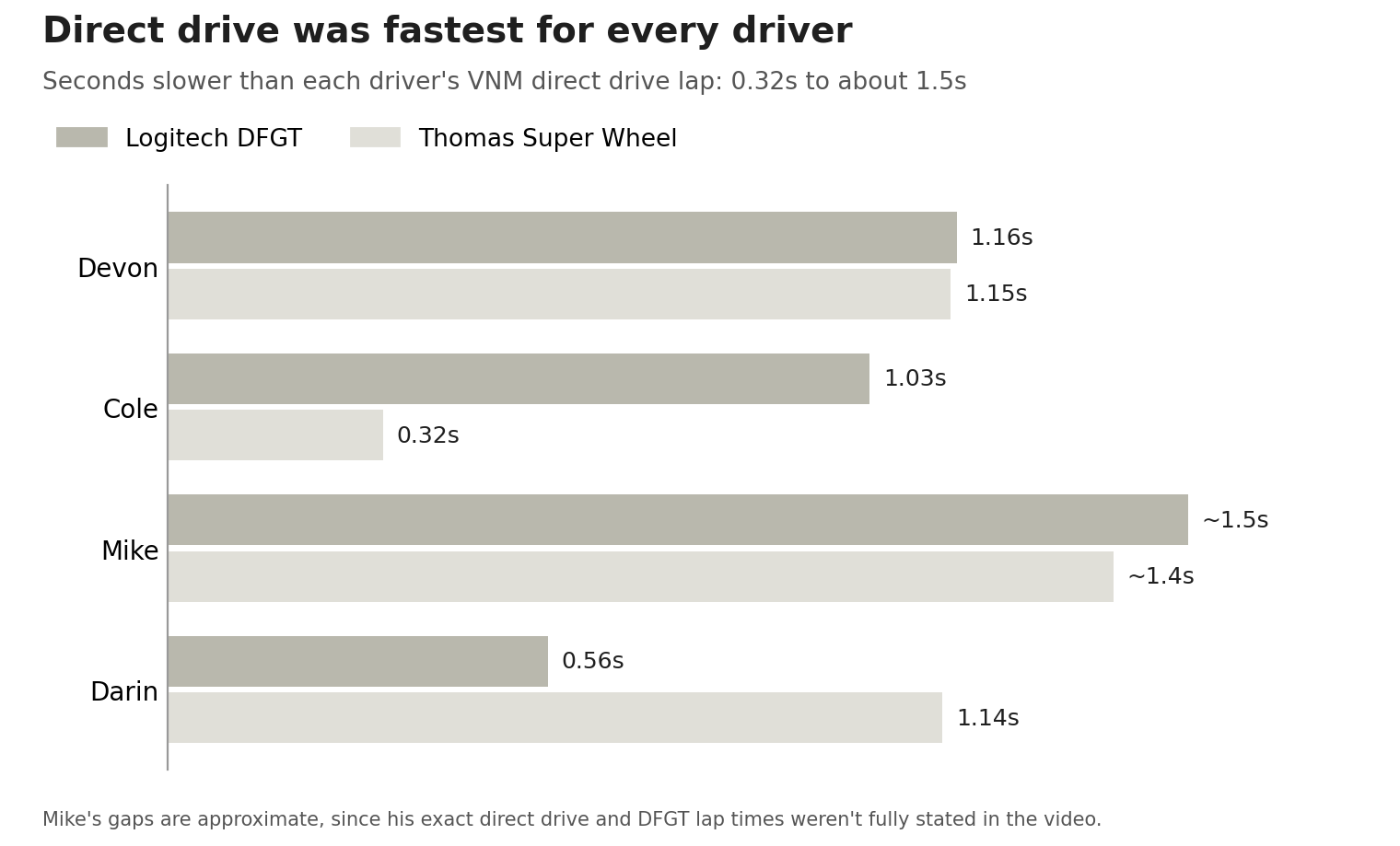
Here are the best laps from each setup, with optimal laps in parentheses where Darin gave them:
| Driver | VNM direct drive | Logitech DFGT | Thomas Super Wheel |
|---|---|---|---|
| Devon Meier | 1:46.697 (1:46.612) | 1:47.857 (1:47.319) | 1:47.848 (1:47.609) |
| Cole Hooper | 1:21.554 | 1:22.586 | 1:21.870 |
| Mike Caminiti | About 2:01.9 (about 2:01.6) | About 2:03.4 (2:02.586) | 2:03.290 (2:02.991) |
| Darin Gangi | 1:45.981 (1:45.667) | 1:46.540 (1:46.145) | 1:47.120 (1:46.839) |
Cole’s best and optimal laps were the same on the VNM and DFGT, because he ran his out lap and one flying lap before his tires started to drop off.
A few things stand out. Devon was almost exactly as fast on the TSW as on the DFGT, about a hundredth apart. Cole’s TSW lap was within about three tenths of direct drive, much closer than his DFGT time. Mike, the most experienced of the three Sim Motion drivers, had the biggest gap of all, around a second and a half.
Darin’s read on it: three of the drivers got comfortable on the DFGT, then carried that into the TSW and were just as dialed in, or a little more. Darin was the exception. He felt more confident on the Logitech, and his times show it.
Wheelbase or Pedals: What the Drivers Said
After the laps, Darin asked each driver the same questions. The biggest one: what made the bigger difference to their lap times, the wheelbase or the pedals? In Darin’s recap, Devon said it was all about the pedals, Mike said it was all about force feedback, and Cole put them about equal.
The Case for Pedals
Neither old pedal set has any resistance, which turned braking into guesswork. Drivers described having to rely on coasting instead of braking, teaching themselves where the brake pedal needed to be by position alone, and brakes that felt like on and off with almost no travel.
“Being able to brake efficiently is huge in racing.”
One driver felt that with VNM’s pedals paired with the Logitech wheel, he could have run very similar times to the full VNM setup.
The Case for Force Feedback
On the other side, the drivers who leaned toward the wheelbase pointed to what force feedback tells you. With the VNM, you feel every bump in the track. With the older wheels, you feel almost nothing, and without force feedback, you lose the sense of where the tires’ limit is.
One driver noticed something unexpected on the TSW: with no force feedback pushing back, it was much easier to throw in too much steering and get the tires into full wheel lock.
Favorites, Nostalgia, and Racing for Real
The old setups still won some hearts. Two of the three Sim Motion drivers picked the TSW: one for its classic spring-loaded feel, the other for nostalgia plus its better mounting and wheel size. The third picked the Logitech, because its bit of force feedback let him feel the game.
Would any of them run an official iRacing race on the old gear? Not with their ratings on the line. But for fun or as a challenge, especially in slower cars like the Mazda MX-5 or Toyota GR86, most said they’d give it a go.
Darin’s Verdict: It’s the Pedals
Darin answered the same questions, and he was clear: the pedals made the bigger difference for him. The load cell brake is what lets you hit your marks and stay consistent, because you brake by muscle memory, how hard you press. On the old pedals, you rely on what he calls positional memory instead: remembering how far down the pedal needs to go, with nothing pushing back to tell you.
“Being able to use muscle memory instead of… positional memory on the old school pedals, it made a huge difference.” Darin Gangi
He’s confident a good set of pedals would improve his times on either old wheel, probably most with the Logitech. Between the two old setups, he felt more confident on the DFGT. The TSW’s 270 degrees of rotation and its shift handle held him back, and even though the TSW pedals were beefier, he got consistent faster on the Logitech’s.
Could he still be competitive on the old gear? He ran a TSW for about 10 years, mostly in NASCAR ovals but quick on road courses too, so with time, yes. Would he run an official iRacing race on one today? On an oval, in a second. On a road course, he wouldn’t risk his iRating or safety rating.
In the comments, Darin added one more thing he wished he’d said on camera: how big a role immersion plays in sim racing for him.
The Socks Story
A small detail from the shop floor: everyone started the test in shoes on the VNM setup. On the old setups, Darin, Cole, and Devon all switched to socks, while Mike kept his shoes on the whole time. Darin stayed in socks when he went back to the VNM, too. At home, on the same VNM pedals, he runs with a sock on his throttle foot because he likes how it slides on the pedal.
What Direct Drive Lap Times Mean for Your Next Upgrade
This was four drivers on four different car and track combos, not a lab study. But it points to a few useful takeaways if you’re deciding where to spend money:
- Direct drive did make every driver faster. The gaps ranged from about three tenths to around a second and a half. That’s real time, but it’s not the same for everyone.
- Don’t skip the pedals. Two of the four drivers, including Darin, said the pedals mattered more than the wheelbase, and one more called it even. If you’re on non-load cell pedals now, a load cell brake may be the bigger upgrade for consistency.
- Familiarity is worth time too. Every driver went faster on their second direct drive run with nothing changed but more laps.
- Speed isn’t the only reason to upgrade. Detail and immersion came up again and again, from the drivers and from viewers.
If you’re shopping for an entry point into direct drive, our MOZA R5 Pro Bundle article(opens in new tab) looks at whether it’s the new budget benchmark, and our Gamescom 2026 sim racing gear roundup(opens in new tab) covers the new direct drive bases PXN showed this year. We asked a similar “does it make you faster?” question about motion in our Simrig SR3 review(opens in new tab).
What the Community Is Saying
Darin asked viewers for their first setups, and the comments turned into a history of sim racing wheels:
- The driver matters most. One viewer is still racing a 16-year-old DFGT at around 3,000 iRating and worries a new wheel won’t make him faster. As we replied, that’s pretty strong evidence the driver matters more than the gear, and an upgrade might be more about the experience than lap time.
- Pedals made the leap. A viewer who went from a Logitech G27 to a MOZA R9 with load cell pedals said the R9 gave more detail and stronger effects, but the pedals were the bigger step forward. Another, after years on wheels from the Logitech Wingman Formula Force GP to a G25 to a MOZA R9, said he didn’t find much difference in speed between wheels, but pedals helped his consistency and better force feedback helped him catch slides.
- Immersion is the point. One viewer argued that for all but the quickest drivers, the real benefit of better gear is immersion. Darin agreed in his reply.
- First-wheel stories. Viewers shared everything from a Mad Catz wheel with about 200 degrees of rotation to a Microsoft force feedback wheel on Xbox 360. One still keeps a T500, a G25, and a Driving Force for older games each one suits best. Our reply pointed out that the G25 was the first wheel ever reviewed on the channel.
Final Thoughts on Direct Drive Lap Times
Does direct drive make you faster? In this test, yes, every time. But the margin depended on the driver, the track, and how comfortable each driver was, and the pedals came up as often as the wheelbase when the drivers explained why. Thirty years of hardware progress is real. So is the fact that a skilled driver on decades-old gear can stay surprisingly close.
What was your first wheel and pedal set, and what do you run now? Tell us in the video comments(opens in new tab) or on the ISR Discord(opens in new tab), and let us know if you’d like to see more tests like this one.
Gear from the modern setup:
- VNM Xtreme 32Nm Direct Drive Wheelbase(opens in new tab)
- VNM Load Cell Pedals(opens in new tab)
- VNM Apex-R Hub(opens in new tab)
- Sim Motion D-Shaped Alcantara Rim(opens in new tab)
- Sim Motion 160mm Premium Aluminum Extrusion Chassis(opens in new tab)
Thanks to Cole’s dad for lending us his TSW.
Disclosure: We sell VNM Simulation products and Sim Motion chassis and rims through Sim Motion, and all four drivers are part of the Sim Motion team. All opinions are our own.